
10 Reasons You Might NOT Want to Move to Seattle in 2026 (Before You Relocate)

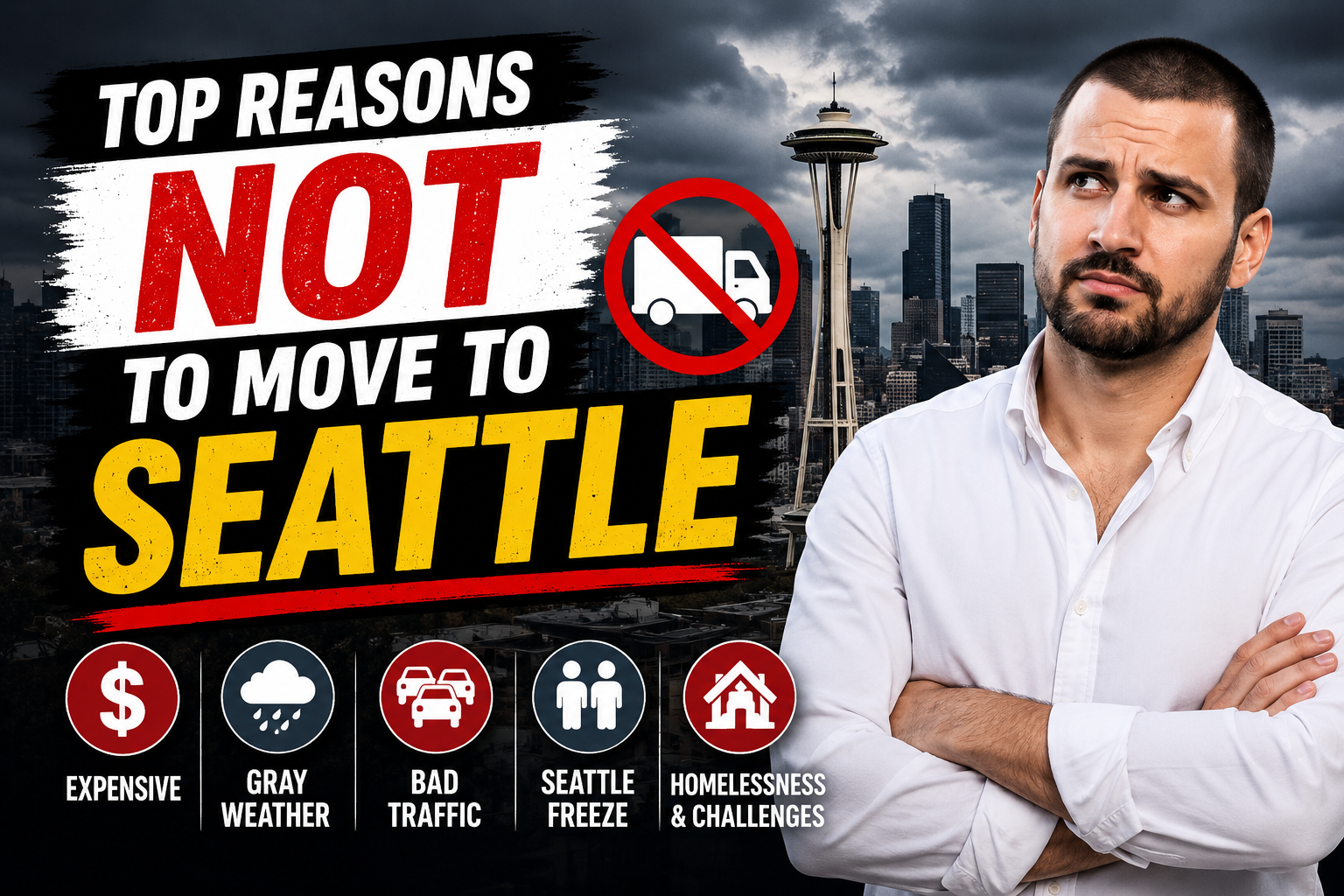
Thinking About Moving to Seattle? Read This First
Seattle has a way of drawing people in. Between the mountain views, Puget Sound, thriving job market, incredible food scene, and endless outdoor recreation, it's easy to understand why so many people decide to relocate here each year.
As someone who was born and raised in the Seattle area and now helps people relocate here full-time as a Realtor, I've had countless conversations with buyers who are excited about the move—but also unsure what life here is really like once the vacation is over.
The reality is that Seattle can be an amazing place to live, but it isn't the right fit for everyone.
The cost of living is high. Traffic can be frustrating. Winters are darker than many people expect. And depending on where you choose to live, your day-to-day experience can look completely different.
This guide isn't meant to convince you not to move here. My goal is to give you an honest picture of what living in Seattle is actually like so you can decide if it matches what you're looking for.
If you'd rather watch than read, you can also check out my full YouTube video below.
Seattle Quick Facts
- 📍 Metro Population: 4+ Million
- 💼 Major Industries: Technology, Healthcare, Aerospace, Biotech, Education
- 🏔️ Known For: Mountains, Puget Sound, coffee, outdoor recreation
- 🌤️ Summer Weather: Warm, dry, and typically in the mid-70s
- 🌧️ Winter Weather: Cool, cloudy, and rainy
- 🚗 Average Commute: Around 30 minutes (varies widely by location)
- 🏡 Home Prices: Among the highest in the Pacific Northwest
- ❤️ Great For: Tech professionals, families, remote workers, and outdoor lovers
1. The Cost of Living Is Higher Than Many People Expect
For most people relocating to Seattle, the biggest adjustment isn't the weather—it's the cost of living.
Yes, home prices tend to grab the headlines, but what surprises many newcomers is how quickly everyday expenses add up. Housing is only one piece of the puzzle. Groceries, gas, dining out, childcare, utilities, parking, insurance, and entertainment all tend to cost more than they do in many other parts of the country.
I've worked with buyers who accepted what looked like a significant salary increase, only to realize a few months after moving that their monthly budget didn't stretch nearly as far as they expected. A larger paycheck doesn't always translate into more financial flexibility when your living expenses increase at the same time.
That's why I encourage buyers to think beyond the purchase price of a home. Your monthly payment is important, but so is everything that comes with living there.
Ask yourself questions like:
- How much will my commute cost in both time and fuel?
- Will I need to pay for parking at work?
- Are childcare costs within my budget?
- Will I still have money left over to enjoy everything Seattle has to offer?
- Am I comfortable with the monthly payment if property taxes fluctuate in the future?
One thing I've seen over the years is that buyers are usually happiest when they leave themselves some financial breathing room.
Sometimes that means choosing a home that's slightly smaller but closer to work. Other times it means looking at nearby cities like Bothell, Renton, or Snoqualmie instead of stretching to buy in one of the area's most expensive neighborhoods.
Buying the biggest house you can qualify for isn't always the decision that leads to the best quality of life. Having room in your budget to enjoy weekends with your family, explore the Pacific Northwest, and handle unexpected expenses often ends up being just as important as the home itself.
2. Why Is Housing So Expensive in Seattle?
If you've started looking at homes around Seattle, you've probably experienced a bit of sticker shock.
Whether you're shopping for a condo in downtown Seattle or a single-family home on the Eastside, prices are significantly higher than what many buyers are used to. One of the first conversations I have with relocation clients is helping them understand why housing costs so much here, because once you understand the market, the prices start to make a lot more sense.
A Strong Job Market Continues to Drive Demand
Seattle has been one of the country's strongest employment hubs for years. Companies like Amazon, Microsoft, Google, Meta, Boeing, and hundreds of other technology, healthcare, aerospace, and biotech companies continue to attract highly skilled workers from around the country and around the world.
Many of those jobs come with salaries that allow buyers to compete aggressively for housing. Even as the market has shifted over the past few years, demand has remained relatively strong because people continue relocating here for career opportunities.
Geography Limits How Much Seattle Can Grow
Unlike many cities that can simply expand outward, Seattle's geography naturally limits development.
To the west is Puget Sound. To the east is Lake Washington. Beyond that, you'll find the Cascade Mountains, while the Olympic Mountains sit across the Sound to the west. Add in protected greenbelts, lakes, and established neighborhoods, and there simply isn't an unlimited amount of land available for new housing.
When demand continues to grow but the amount of buildable land stays relatively limited, prices naturally remain elevated.
New Construction Hasn't Fully Kept Up
You'll notice cranes throughout Seattle and the surrounding suburbs, and new communities continue to be built across the region. Even with all that construction, it hasn't always been enough to keep pace with population growth and job creation.
Many of the newer homes that do come to market are also larger, higher-end properties, which means they don't necessarily improve affordability for first-time buyers.
Competition Is Still Common in Desirable Areas
One thing that surprises many buyers is that multiple-offer situations haven't disappeared.
While the market isn't as competitive as it was during the peak of 2021 and early 2022, well-priced homes in desirable neighborhoods can still receive multiple offers, especially if they're updated, located within highly sought-after communities, or priced appropriately from the start.
As a buyer, it's important to be prepared without feeling like you have to rush into the wrong home. I've seen buyers lose out on a few houses before finding one that ended up being an even better fit.
The Good News: You Have More Options Than You Might Think
One of the biggest misconceptions I hear is that if you can't afford Seattle itself, you can't afford the Seattle area.
In reality, there are dozens of communities throughout the region that offer different price points, commute times, and styles of living. Depending on what's most important to you, places like Bothell, Renton, Snoqualmie, North Bend, Maple Valley, or parts of Tacoma may provide more space for your budget while still offering access to many of the things that make the Pacific Northwest such a great place to live.
That's one of the reasons I always recommend starting with your overall goals instead of a specific city. Once we talk through your budget, commute, work location, and the type of home you're looking for, it becomes much easier to narrow down the areas that make the most sense for your situation.
3. Traffic Can Have a Bigger Impact Than You Expect
If there's one thing almost every newcomer underestimates, it's Seattle traffic.
People often look at a map and think, "Fifteen miles? That should only take twenty minutes." Around here, that's not always how it works.
Depending on the time of day, weather, construction, or an accident, a 15-mile drive can easily turn into a 45-minute—or even hour-long—commute. It's one of the biggest reasons I encourage buyers to think about their daily routine before falling in love with a particular home.
Distance Doesn't Tell the Whole Story
One of the first things I explain to relocation clients is that commute times matter far more than mileage.
You might find two homes that are the same distance from your office, but one could take twice as long to reach because of traffic patterns, highway bottlenecks, or bridge crossings.
For example, a home that's 20 miles from downtown Seattle isn't necessarily easier to commute from than one that's 30 miles away. The route itself often matters more than the actual distance.
That's why I always recommend plugging your commute into Google Maps during the times you would actually be driving—not just in the middle of the day when traffic is light.
Traffic Isn't Just a Seattle Problem Anymore
Many people assume that traffic only affects downtown Seattle, but that's no longer the case.
As the region has grown, congestion has spread throughout much of the metro area. You'll regularly encounter heavy traffic in places like Bellevue, Redmond, Lynnwood, Everett, Kent, Renton, Tacoma, and along much of the I-405 corridor.
If you're moving here for work, it's worth spending some time understanding where the major traffic bottlenecks are before choosing a neighborhood.
Weather Can Make Commutes Even Longer
Seattle doesn't typically get heavy rainstorms, but even light rain can noticeably slow traffic.
When roads are wet, people naturally drive more cautiously, and that often leads to longer travel times. Add construction, an accident, a sporting event, or a ferry backup into the mix, and your commute can quickly become much longer than expected.
Fortunately, major snowstorms are relatively uncommon in Seattle itself. However, when snow does fall, especially on the city's steep hills, travel can become extremely difficult until roads are cleared.
Your Commute Affects More Than Your Schedule
As a dad with two young boys, I've realized that commute time isn't just about getting from Point A to Point B.
Every extra 30 minutes spent in traffic is 30 fewer minutes at home.
That's less time having dinner together, playing outside, helping with bedtime, or simply relaxing after work. I've also worked with buyers who purchased what they thought was their dream home, only to realize a few months later that they dreaded making the drive every day.
Moving again because you dislike your commute is a much bigger challenge than choosing the right location from the start.
Think About Your Daily Routine—Not Just the House
One thing I've noticed after helping so many people relocate is that the happiest homeowners usually aren't the ones who bought the biggest house.
They're the ones who found the right balance.
For some people, that means living closer to work and choosing a slightly smaller home. Others are perfectly happy with a longer commute if it means having more space, a larger yard, or a neighborhood that better fits what they're looking for.
There's no one-size-fits-all answer, but it's worth thinking through how you'll actually live day to day before making a decision.
After all, you'll drive that commute hundreds of times each year. It's one of those details that doesn't always seem important while you're house hunting—but it can have a huge impact on your overall experience once you've settled in.
4. Seattle's Gray Winters Aren't for Everyone
One of the first things people ask me about moving to Seattle is whether it really rains all the time.
The answer is... not exactly.
Seattle certainly has a reputation for rain, but what surprises many newcomers is that it's usually not heavy downpours. Instead, you'll experience long stretches of overcast skies, light drizzle, and cloudy weather, especially from late fall through early spring.
If you're moving from somewhere that gets sunshine almost every day, that adjustment can take some time.
The Darkness Is Often Harder Than the Rain
In my experience, most people don't struggle with the rain nearly as much as they struggle with the shorter days.
Around December, the sun sets before many people even leave work. There are stretches where you'll head to the office in the dark and drive home in the dark.
That can catch people off guard, especially during their first winter in the Pacific Northwest.
I've talked to quite a few relocation clients who told me the lack of daylight was one of the biggest adjustments after moving here—not because the weather was terrible every day, but because it simply felt like there were fewer hours of daylight to enjoy.
You Learn to Embrace the Outdoors
One thing I've noticed about people who truly enjoy living in Seattle is that they don't wait for perfect weather.
They still go for walks.
They still hike.
They still visit parks.
They still spend time outside with family and friends.
Our family is the same way. Even when it's drizzling, we'll take the boys to the park, walk the dogs, or get outside for a while. Around here, you quickly realize that if you only go outside when it's sunny, you'll miss out on a lot of what makes the Pacific Northwest such a great place to live.
A good rain jacket ends up getting a lot more use than an umbrella.
Then Summer Arrives... and Everything Changes
The flip side is that Seattle summers are absolutely incredible.
From late June through early September, you'll often get warm, dry weather with very little humidity. Days are long, sunsets are late, and it feels like the entire region comes alive.
Restaurants open their patios, parks fill up with families, boats cover the lakes, hiking trails are packed, and nearly every weekend there's another festival or event happening somewhere around the region.
It's one of the biggest reasons so many people fall in love with living here.
Is the Weather a Dealbreaker?
For some people, yes.
If year-round sunshine is one of your highest priorities, Seattle may not be the right fit.
But if you don't mind a few gray months in exchange for beautiful summers, incredible outdoor recreation, and four distinct seasons, many people feel it's a tradeoff they're happy to make.
One thing I've seen after helping so many people relocate is that expectations make a huge difference. People who move here knowing what winter is actually like—and who plan to stay active during those darker months—generally adjust much better than those expecting the weather to feel like Southern California.
5. Is the "Seattle Freeze" Actually Real?
If you've spent any time researching Seattle, you've probably come across the term "Seattle Freeze."
The idea is that people here are polite, but it can take longer to build close friendships than it does in other parts of the country.
So... is it true?
From my experience, there's at least some truth to it—but I also think it's often misunderstood.
People Are Friendly, But They May Already Have Established Routines
One thing I've noticed is that most people in the Seattle area aren't unfriendly at all.
You'll find people who are courteous, respectful, and happy to chat while you're walking the dog, grabbing coffee, or waiting for your kids at the park.
What can be different is that many adults already have established routines. Between demanding careers, family commitments, youth sports, hiking on weekends, skiing during the winter, and spending time with longtime friends, people often have pretty full schedules.
That can make it feel a little harder to break into new social circles compared to some other cities.
Honestly, This Isn't Just a Seattle Thing
I also think it's important to put this into perspective.
Making new friends as an adult is difficult almost anywhere.
When you're in school or college, you're constantly surrounded by people in the same stage of life. As adults, friendships usually take a little more intention, regardless of where you live.
Seattle gets labeled for this more than many cities, but I've had relocation clients tell me they've experienced something similar after moving to plenty of other metropolitan areas.
The Good News Is That Community Is Easier to Build Than You Might Think
One of the things I enjoy about living here is how many ways there are to meet people who share your interests.
If you enjoy hiking, there are countless hiking groups throughout the region.
If you're into mountain biking, skiing, running, paddleboarding, or pickleball, you'll find active communities all over the Seattle area.
For families, local parks, neighborhood events, youth sports, libraries, and school activities naturally create opportunities to meet other parents.
Our family has found that having two young boys and two dogs has introduced us to people we probably never would have met otherwise. Whether it's at the neighborhood park, out walking the dogs, or attending community events, those everyday interactions gradually turn familiar faces into friendships.
Give It Time
If you move to Seattle, don't expect to build your entire social circle during your first month.
Like any major life change, it takes time.
The people I've seen settle in most successfully are usually the ones who make an effort to explore their community, try new activities, and say yes to opportunities that come along.
Before long, favorite coffee shops become familiar, neighbors start recognizing each other, and the city begins to feel a lot smaller than it did at first.
Should the Seattle Freeze Stop You From Moving Here?
Personally, I don't think so.
I think it's simply something to be aware of if you're relocating.
Building friendships may take a little patience, but once people establish those relationships, they often become lasting ones. If you're willing to get involved in your community and put yourself out there, there's a good chance you'll find your place here just like so many others have.
6. Homelessness and Public Safety Vary Significantly by Neighborhood
One of the questions I get asked most often from people relocating to Seattle is about homelessness and public safety.
The honest answer is that it depends entirely on where you're looking.
Like most major cities, Seattle has areas where homelessness is more visible than others. In parts of downtown, as well as some surrounding neighborhoods, you'll likely encounter people experiencing homelessness, along with issues related to addiction and mental health.
For some buyers, especially those coming from smaller towns or suburban communities, it's one of the biggest adjustments after moving here.
Seattle Isn't One Neighborhood
One thing that's important to understand is that people often talk about Seattle as if it's one place.
In reality, it's a collection of very different neighborhoods, each with its own personality, amenities, and day-to-day feel.
You can drive 10 or 15 minutes and have a completely different experience.
Some neighborhoods are highly walkable with busy commercial districts, restaurants, and nightlife. Others are primarily residential with quiet streets, neighborhood parks, and a slower pace.
That's one of the reasons I always encourage buyers to spend time exploring multiple areas before deciding where they want to live.
Many Buyers Expand Their Search After Visiting
Something I've seen happen quite a bit is that buyers initially tell me they want to live in downtown Seattle because that's the part of the city they're most familiar with.
Then they spend a few days exploring different communities, and their priorities start to shift.
Some discover they prefer the waterfront feel of West Seattle. Others find themselves drawn to neighborhoods on the Eastside like Bellevue, Kirkland, Redmond, or Sammamish. I've also had buyers fall in love with places like Edmonds or Bothell because they offered the balance they were looking for between convenience, outdoor recreation, and a quieter residential setting.
There's no right or wrong answer—it really comes down to what fits your priorities and how you want your day-to-day life to look.
Visit During Different Times of Day
One piece of advice I almost always give relocation buyers is to visit the neighborhoods you're considering more than once if you have the opportunity.
Walk around during the afternoon.
Come back in the evening.
Grab a cup of coffee nearby.
Visit a local park.
Drive the commute you'll actually be making.
Doing that often gives you a much better feel for an area than simply looking at listing photos online.
Don't Let Headlines Make the Decision for You
Seattle receives a lot of national media attention, and it's easy to form an opinion based solely on headlines or social media.
The reality is much more nuanced.
There are vibrant urban neighborhoods, quiet residential communities, waterfront areas, suburban neighborhoods, and everything in between. Every city has areas that may be a better fit for certain buyers than others, and Seattle is no different.
That's why I always recommend focusing less on broad generalizations and more on finding the specific neighborhood that aligns with your budget, commute, and what you want your everyday experience to look like.
7. Seattle Has a Strong Job Market—But It's Also Highly Competitive
One of the biggest reasons people move to Seattle is for career opportunities.
The region has one of the strongest job markets in the country, attracting professionals from across the United States and around the world. While Seattle is often associated with the tech industry, the local economy is much more diverse than many people realize.
If you're relocating here for work, there's a good chance you'll find opportunities in a wide range of industries.
Technology Is Still a Major Economic Driver
When most people think of Seattle, they think of companies like Amazon and Microsoft—and for good reason.
The Seattle area is home to some of the world's largest technology companies, along with thousands of startups and growing businesses. Software engineers, project managers, data analysts, cybersecurity professionals, and many other technology-related careers continue to be in high demand throughout the region.
The Eastside, including Bellevue and Redmond, has become an especially popular destination for technology professionals, with many major employers expanding their presence there over the past several years.
There Are Opportunities Beyond Tech
While technology receives most of the attention, it's far from the only industry keeping the local economy strong.
Healthcare is one of the region's largest employers, with hospitals and medical centers throughout the Seattle area continuing to hire.
Aerospace remains an important part of the local economy, thanks in large part to Boeing and its extensive network of suppliers.
Education, biotechnology, engineering, construction, maritime industries, and professional services also provide thousands of jobs across the region.
That's one of the reasons Seattle has remained attractive to so many people. The economy isn't built around just one industry.
Higher Salaries Don't Always Mean More Spending Power
One thing that surprises many people relocating here is that a higher salary doesn't automatically translate into a higher standard of living.
It's not uncommon for someone to receive a significant raise when accepting a position in Seattle, only to discover that housing, childcare, transportation, and everyday expenses consume much of that additional income.
That's why I always encourage buyers to look at the complete financial picture instead of focusing solely on salary.
A position paying $175,000 in Seattle may provide a similar level of financial comfort as a lower salary in a less expensive part of the country, depending on your housing costs and overall budget.
Financial Planning Makes the Move Much Easier
Before relocating, it's worth taking some time to estimate your monthly expenses—not just your mortgage or rent.
Think about things like commuting costs, childcare, utilities, groceries, insurance, and how often you plan to enjoy everything the area has to offer.
I've found that buyers who take the time to build a realistic budget before moving tend to feel much more confident in their decision and experience fewer surprises after they arrive.
Is Seattle a Good Place to Build a Career?
For many people, absolutely.
Seattle continues to attract ambitious professionals because of its strong economy, career growth opportunities, and diverse industries.
Just remember that those opportunities also attract a lot of talented people. Depending on your field, competition can be strong, so it's helpful to have a job lined up—or at least a clear plan—before making the move.
If you do, Seattle can be an incredible place to grow both professionally and personally.
8. Seattle Isn't the Right Fit for Everyone
Categories
Recent Posts